
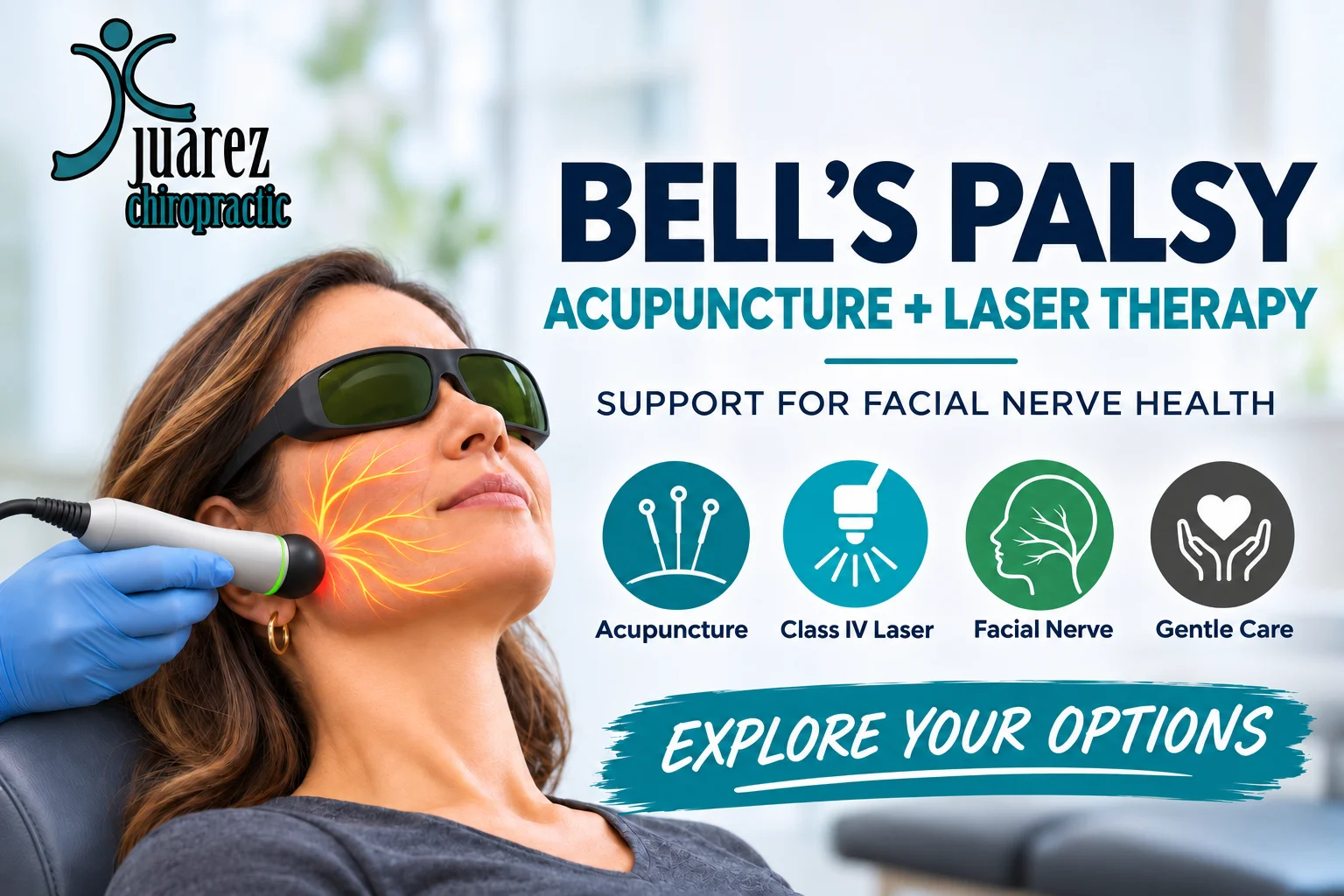
Waking up and noticing that one side of your face won't move is a jarring experience. For most people, that's what Bell's palsy looks like. The eyelid droops, the corner of the mouth sags, and smiling or closing your eye on that side becomes difficult or impossible. It can come on over just a day or two, and the cause isn't always obvious. Most cases resolve on their own over weeks to months, but many people want to do something to help the process along rather than just wait.
Acupuncture and Class IV laser therapy (also known as high-power photobiomodulation) are two drug-free approaches that practitioners have used to support nerve recovery in Bell's palsy. Here's what each one involves and why it may be worth considering.
What Is Bell's Palsy, Exactly?
Bell's palsy is a sudden, temporary weakness or paralysis of the muscles on one side of the face. It happens when the facial nerve (the seventh cranial nerve) becomes inflamed, usually after a viral infection. The nerve runs through a narrow bony canal in the skull, and when it swells, that tight space causes pressure and disrupts the nerve signals going to your facial muscles.
Common symptoms include drooping on one side of the face, difficulty closing one eye, drooling, changes in taste, and sensitivity to sound. Most people recover fully, but some are left with lingering weakness or what's called synkinesis, where the muscles move in unintended ways. Getting the nerve to heal completely, and quickly, is the main goal of any treatment.
How Acupuncture May Help
Acupuncture involves placing very fine needles at specific points along the face and body. From a traditional standpoint, this is meant to restore the flow of energy through pathways called meridians. From a more modern, physiological standpoint, the needle stimulation appears to increase local circulation, reduce inflammation, and encourage nerve tissue to repair itself.
What the Research Suggests
Several studies and clinical reviews have looked at acupuncture for Bell's palsy, and the results are generally encouraging. A number of trials have found that patients who received acupuncture in the early stages of Bell's palsy recovered faster and more completely compared to those who received medication alone or no treatment. The evidence isn't perfect, and more rigorous research is still needed, but the side effect profile of acupuncture is very low, which makes it a reasonable option to explore alongside conventional care.
What a Typical Treatment Looks Like
Acupuncture for Bell's palsy usually targets points on the face itself, around the eye, cheek, jaw, and mouth. Sessions typically run about 20 minutes, and a course of treatment might involve two to three sessions per week over several weeks, depending on how the person is responding.
Class IV Laser Therapy for Facial Nerve Recovery
Class IV laser therapy uses high-power, specific wavelengths of light to penetrate deeply into tissue. Unlike lower-powered laser devices, Class IV lasers deliver greater energy output, allowing the light to reach deeper structures along the nerve pathway more effectively. The treatment is comfortable and non-invasive. The light energy is absorbed by cells and appears to support energy production inside them, which can accelerate tissue repair, reduce inflammation, and encourage nerve regeneration.
Why Class IV Laser Therapy Makes Sense for Bell's Palsy
The facial nerve travels through several deeper structures of the face and skull that lower-powered devices may not adequately reach. The increased power of a Class IV laser allows for greater tissue penetration, making it particularly well-suited for targeting the inflamed nerve at the root of Bell's palsy. Research on high-power photobiomodulation for nerve injuries has shown promising results in terms of reducing inflammation and encouraging nerve regeneration. Some practitioners combine Class IV laser therapy with acupuncture to address the nerve from multiple angles at once.
The treatment itself is straightforward. The laser handpiece is applied over the affected areas of the face and along the path of the facial nerve, typically for a few minutes per area. Patients often describe a gentle warming sensation. There is no cutting, no needles involved with the laser itself, and no recovery time afterward.
When to Start and What to Expect
Timing matters with Bell's palsy. Most providers recommend starting treatment as early as possible, ideally within the first week or two of onset. The nerve is more responsive early on, and getting circulation and nerve activity supported quickly may reduce the chance of longer-term weakness.
Results vary from person to person. Many people begin noticing small improvements within a few weeks of consistent treatment. Twitching or subtle movement returning to a previously paralyzed area is often one of the first signs that the nerve is waking back up.
These therapies work best as part of a broader care plan. If a physician has prescribed antiviral medication or steroids, acupuncture and Class IV laser therapy can typically be used alongside those without conflict. Our services page has more detail on what we offer and how we approach cases like this.
Is This Right for You?
If you or someone you know is dealing with Bell's palsy or any form of facial paralysis, it's worth having a conversation about what options are available. Drug-free therapies like acupuncture and Class IV laser therapy aren't a guarantee, but they carry very little risk and have helped many people recover more fully and more quickly than they would have otherwise.
We'd be glad to talk through your situation and put together a plan that makes sense. Reach out to us to get started.