
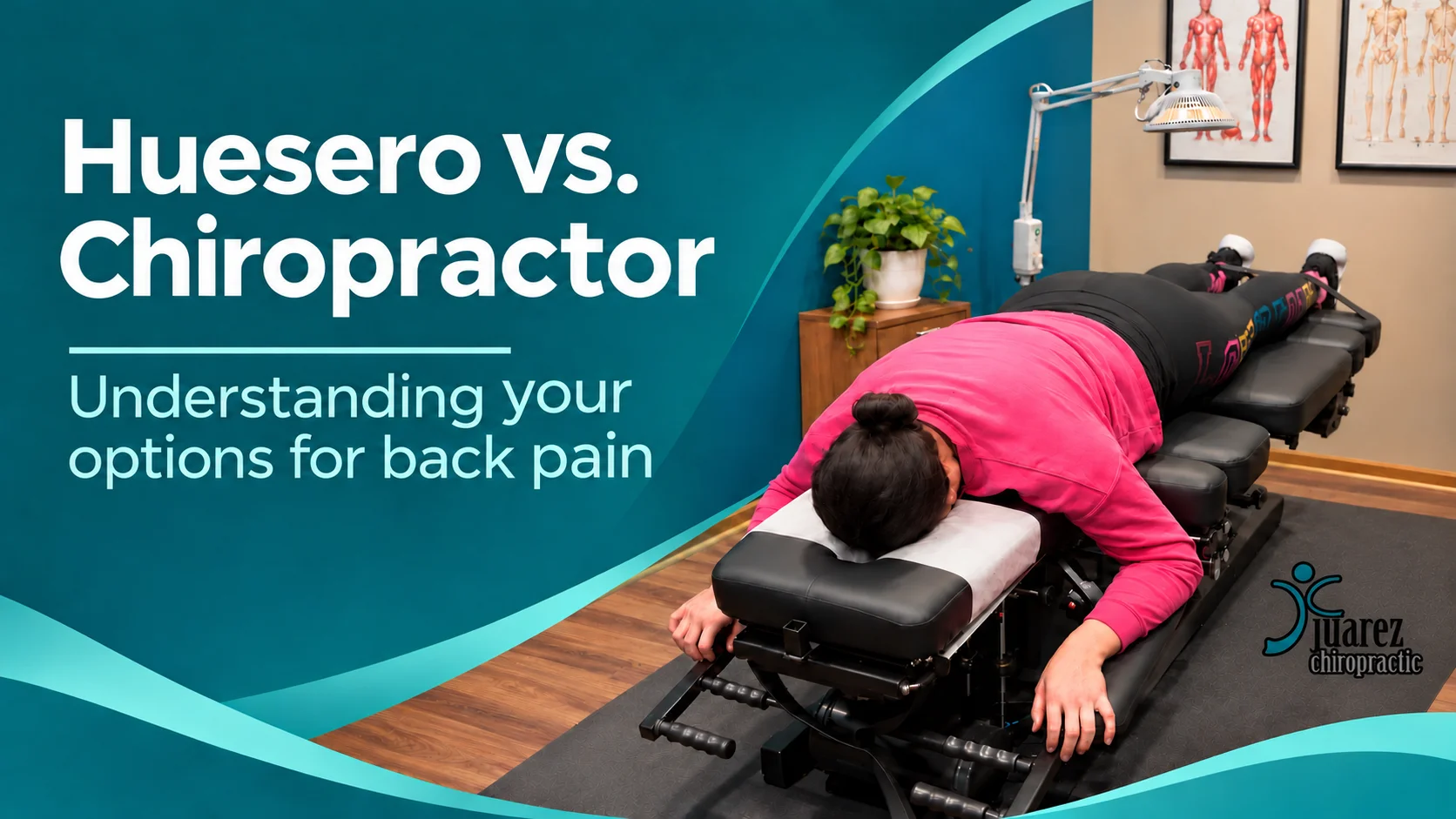
If you grew up in a Mexican or Latin American household, there's a good chance you heard about the huesero long before you ever heard the word "chiropractor." Maybe your abuela swore by one, or your parents took you to a sobador after a bad fall. That tradition is real, and it deserves to be treated with respect, not dismissed. At the same time, if you're dealing with serious or persistent pain, it helps to understand what each type of care actually involves, so you can make a smart choice for your body.
What Is a Huesero or Sobador?
The terms are often used interchangeably, though they can carry slightly different meanings depending on the region. A huesero (literally "bone person") is a traditional healer who works with bones and joints, often by manipulation or realignment. A sobador focuses more on soft tissue, using rubbing and massage techniques to address muscle tension and discomfort.
These practices have been passed down through generations, rooted in Indigenous and folk medicine traditions across Latin America. They fill a real need, especially in communities where access to formal healthcare has historically been limited. Many people report feeling relief after visiting a huesero, and that experience is worth taking seriously.
That said, traditional healers typically learn their craft through apprenticeship and experience, not through standardized clinical training or licensure. There is no formal credentialing body, no licensing exam, and no uniform standard of care. That is not a criticism of the tradition itself, but it is important information when you are weighing your options.
What Is a Licensed Chiropractor?
A Doctor of Chiropractic (DC) is a licensed healthcare provider who has completed a doctoral-level graduate program, typically four years on top of undergraduate education. The curriculum includes anatomy, physiology, biomechanics, radiology, neurology, and clinical diagnosis, alongside hands-on training in spinal and joint manipulation.
In Illinois, chiropractors must pass national board exams administered by the National Board of Chiropractic Examiners and obtain a state license before they can practice. They are also required to complete continuing education hours to keep that license active. This means there is accountability built into the system: a licensing board, a code of professional conduct, and a legal framework that protects patients.
What Chiropractors Actually Do
Chiropractors assess your musculoskeletal system using physical examination and sometimes imaging like X-rays. They identify restrictions or misalignments in the spine and joints, then use specific, controlled techniques to address them. The goal is to restore proper movement, reduce nerve irritation, and relieve pain without drugs or surgery.
At Juarez Chiropractic, we treat conditions like back pain, neck pain, sciatica, herniated discs, and sports or work injuries. You can learn more about those services at our services page.
Safety: An Honest Comparison
Chiropractic care, when performed by a licensed provider, has a strong safety record. Serious adverse events are rare. Because chiropractors are trained in clinical diagnosis, they also know when to refer out. If your pain is caused by something that needs imaging, specialist care, or emergency attention, a good chiropractor will tell you that and point you in the right direction.
With a traditional huesero, the safety picture is harder to assess. Some practitioners are genuinely skilled and cause no harm. Others may not recognize when a condition is beyond the scope of manual therapy, or may apply techniques to injuries that actually need imaging first (a fracture, for example, should be identified before anyone starts manipulating a joint). Without formal training in clinical assessment, those distinctions can get missed.
This is not about one tradition being better than another. It is about matching the right level of care to what your body actually needs.
When Should You Choose Licensed Chiropractic Care?
Consider coming to a licensed chiropractor if any of the following apply:
- Your pain has lasted more than a few days and is not improving
- You had an injury from a car accident, fall, or workplace incident
- You have numbness, tingling, or weakness in your arms or legs
- You have a known disc problem, arthritis, or prior spine surgery
- You want a diagnosis, not just treatment
- You need documentation for an insurance claim or legal case
In these situations, a licensed provider who can examine you, review your history, and order imaging if needed is the appropriate starting point.
Bilingual Care on the South Side
One reason many Spanish-speaking patients have historically turned to hueseros is simple: they could communicate comfortably. Explaining where it hurts, understanding what a provider is telling you, feeling heard in your own language, that matters enormously in healthcare.
Dr. Rodrigo Juarez is a bilingual chiropractor serving Brighton Park, Back of the Yards, and the surrounding South Side neighborhoods. Most appointments are conducted in whichever language you are more comfortable in, Spanish or English. You do not have to choose between getting licensed care and being understood.
If you have been relying on traditional remedies because language felt like a barrier to formal care, we hope that changes things a little. You can reach out through our contact page to ask questions or schedule a visit, in Spanish if you prefer.
The Bottom Line
Hueseros and sobadores represent a meaningful tradition in many families, and that history deserves respect. For everyday muscle soreness or minor strains, some people find comfort in those traditional approaches. But if your pain is serious, persistent, or the result of an injury, licensed chiropractic care offers something different: clinical training, diagnostic tools, legal accountability, and a treatment plan built around your specific condition. And at Juarez Chiropractic, you can get all of that without leaving your language at the door.